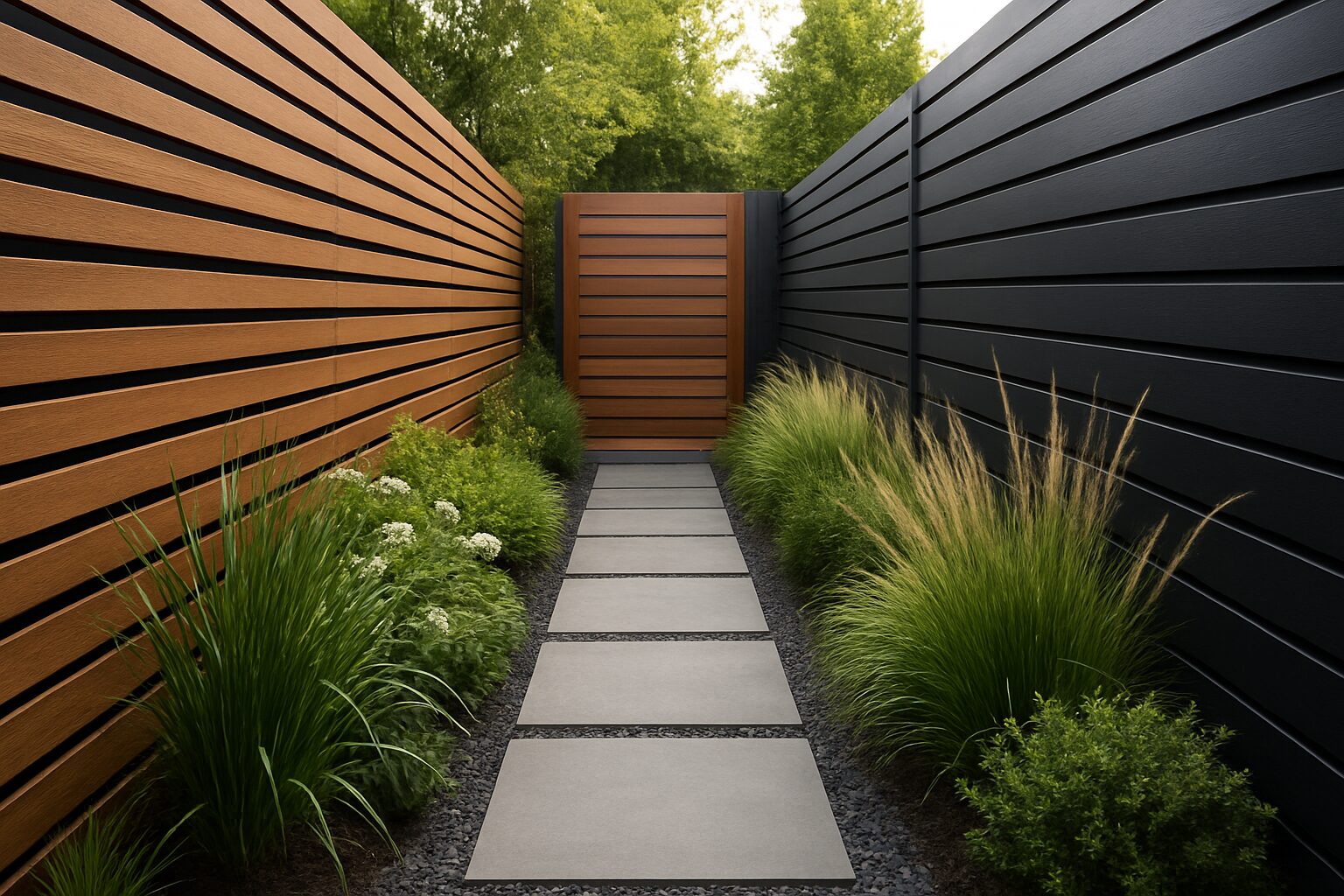
A six-foot fence looks perfectly normal around a large garden. Put that same fence on both sides of a narrow terrace garden and the effect can be completely different.
Suddenly, the space feels more like a corridor than somewhere you’d want to sit on a summer evening.
I’ve seen this countless times around Leeds, particularly with Victorian terraces, compact semis and newer housing developments where every square metre of outdoor space matters. Homeowners often assume the answer is to install the same fencing they’d choose for a larger property, just with fewer panels.
It rarely works that simply.
Good garden fencing should suit the space around it. In a narrow garden, small decisions about height, colour, post position and panel design can change how the whole area feels.
When people start looking for garden fencing in Leeds, the conversation often begins with privacy. That’s understandable. But in smaller gardens, privacy is only half the job.
You also need to think about light, access, drainage and how much usable space the fencing itself will occupy.
Get those details wrong and even expensive fencing can make a small garden feel worse.
Small Gardens Expose Every Mistake
One thing I’ve learnt from working in narrow gardens is that there’s nowhere to hide poor workmanship.
In a large garden, a slightly uneven fence line might go unnoticed. A flowerbed, tree or shed breaks up the view.
In a garden that’s only three or four metres wide, everything is visible.
A leaning post stands out. Uneven panel heights become obvious. A poorly positioned gate can make the entire space awkward to use.
Even the direction of the boards matters.
Horizontal fencing tends to draw the eye along the boundary. In some gardens, that creates a sense of length. In others, particularly very narrow plots with tall boundaries, it can make the space feel even more enclosed.
Vertical boards often work better where the aim is to create a sense of height without drawing attention to the garden’s limited width.
There’s no universal rule.
You have to stand in the garden and look at it properly.
Privacy Can Come at the Expense of Daylight
This is probably the biggest mistake homeowners make.
They want privacy, so they ask for the tallest fence possible.
Sometimes that makes sense. If neighbouring windows overlook a seating area, screening can make a garden much more comfortable.
But a tall, solid fence can also block a surprising amount of daylight.
In narrow gardens, that matters enormously.
I’ve worked in properties where replacing an old, lower boundary with a taller solid fence made the garden noticeably darker. The customer gained privacy but lost afternoon sunshine across the patio.
Not exactly the result they wanted.
Before choosing fence height, watch where the sun moves throughout the day.
A south-facing garden behaves differently from a north-facing one. The height and position of neighbouring buildings also affect how much light reaches the ground.
And don’t forget the rules. In England, fencing over two metres high will normally require planning permission, while lower limits can apply beside highways. Local restrictions and property conditions can also change what’s permitted.
Privacy is important.
So is having somewhere pleasant to sit.
Fence Colour Changes How Wide a Garden Feels
Dark fencing has become popular over recent years.
Charcoal, black and deep brown finishes can look excellent, especially against green planting.
There’s a reason people like them.
Dark backgrounds can make foliage stand out and help boundaries appear less visually busy. In some narrow gardens, that makes the space feel calmer.
But I wouldn’t automatically recommend dark fencing everywhere.
A very shaded garden surrounded by tall buildings can feel gloomy if every boundary is painted black.
Lighter timber finishes may work better.
Natural pressure-treated timber also changes colour as it ages. That fresh greenish or brown treatment shade won’t remain forever. Without a decorative finish, many timber products gradually weather towards grey.
Some homeowners love that.
Others don’t.
It’s worth deciding which camp you’re in before installation rather than discovering three years later that you dislike the weathered appearance.
Losing Six Inches Can Matter More Than You Think
In a large garden, moving a fence line slightly might make little practical difference.
In a narrow terrace garden, losing even 150mm of width can affect how the space works.
That could be the difference between fitting a garden table comfortably and having to squeeze past it.
It’s one reason boundary positions need careful consideration.
Old fencing isn’t always installed exactly where people assume the legal boundary sits. Posts may have been positioned to avoid foundations, roots or other obstacles.
Removing the old fence and installing new posts in a different position without checking can create problems.
I’ve seen homeowners assume they could simply move a fence closer to the neighbour’s garden because the original posts looked slightly offset.
That’s not a decision to make casually.
Check the boundary position and establish any shared responsibilities before work begins.
An extra few inches of garden isn’t worth a long-running neighbour dispute.
Traditional Featheredge Still Has Its Place
Modern fencing designs get plenty of attention, but traditional featheredge remains one of my preferred options for many compact gardens.
It’s strong, adaptable and works particularly well on awkward boundaries.
Older Leeds properties rarely have perfectly straight gardens.
Walls lean slightly. Ground levels change. Boundaries narrow towards the back.
Rigid prefabricated panels can make those irregularities difficult to accommodate.
Featheredge fencing built on site gives installers more flexibility.
Boards can follow the boundary properly, and stepped sections can deal with changes in ground level.
That doesn’t mean every narrow garden needs featheredge.
Decorative panels, hit-and-miss fencing and slatted systems all have their uses.
The mistake is choosing a style before understanding the site.
Access Can Double the Difficulty of Installation
Here’s something that rarely appears in glossy garden design articles.
How are the materials getting into the garden?
Many Leeds terraces have no direct rear access. Everything has to come through the house, down a narrow passage or along a shared access route.
That changes the job.
Concrete posts are heavy. Full-size fence panels can be awkward to carry through tight spaces. Removing old concrete foundations creates rubble that has to go somewhere.
I’ve worked on jobs where moving materials took almost as long as installing the fencing.
And that’s before considering freshly decorated hallways, narrow doorframes or expensive kitchen floors.
Good fencing contractors should assess access before quoting, not discover the problem when the delivery arrives.
Sometimes constructing fencing on site from individual components makes far more sense than trying to manoeuvre large panels through a Victorian terrace.
It may take longer to build.
It can save a great deal of trouble.
Narrow Gardens Often Have Awkward Drainage
Small gardens can be surprisingly difficult when it comes to water.
Patios frequently cover most of the available ground. Raised beds sit directly against boundaries. Sheds and outbuildings leave very little exposed soil.
Rainwater still needs somewhere to go.
If a new patio slopes towards the fence, water can collect around the posts and gravel boards.
Timber doesn’t appreciate sitting permanently damp.
Neither does the ground supporting the posts.
In parts of Leeds where clay soil is common, water can remain close to the surface for long periods during winter.
One thing I often advise is leaving enough space around the base of the fencing for inspection and maintenance.
Don’t bury timber gravel boards beneath decorative stone or raised planting beds.
And don’t assume a narrow strip of gravel automatically solves a drainage problem. Water needs a suitable route away, not merely somewhere to collect out of sight.
Gates Deserve More Thought in Small Spaces
A poorly positioned garden gate can be a daily nuisance.
In a large garden, you have room to work around it.
In a narrow garden, a gate swinging the wrong way might block a path, hit a planter or prevent a wheelie bin from passing.
Think about how you’ll actually use the space.
Will you need to bring bicycles through?
Move bins?
Carry garden furniture?
Get a lawnmower or wheelbarrow into the back garden?
The clear opening width matters more than people realise.
Gate posts also need proper support. Gates place repeated loads on hinges, especially when they’re opened and closed frequently.
I’ve seen narrow garden gates hung from posts that were barely adequate for ordinary fencing.
A couple of years later, the latch no longer lines up.
That’s usually a post problem, not a latch problem.
Slatted Fencing Can Work Beautifully
I’m not against modern slatted fencing.
Quite the opposite.
In the right narrow garden, it can look fantastic.
The clean lines suit contemporary patios and compact outdoor seating areas. Depending on the design, gaps between boards can also allow some airflow and filtered light.
But there’s a difference between decorative screening and a proper boundary fence.
Some lightweight slatted systems are better suited to sheltered areas than exposed garden boundaries.
Wind loading still matters.
So does the strength of the supporting frame.
If you’re using slatted fencing to create privacy, check the viewing angles too. Gaps that look small when viewed straight on can offer considerably less privacy from neighbouring windows.
It’s a detail that’s easy to miss in photographs.
Don’t Fill Every Boundary With Planting
Garden designers often recommend softening fencing with plants.
That’s generally good advice.
But narrow gardens need restraint.
Large shrubs can quickly consume valuable floor space. Heavy climbing plants can place substantial loads on timber panels. Dense planting also makes future repairs harder.
I’ve removed fencing hidden behind mature ivy where the homeowner hadn’t seen the actual boards for years.
The plants looked healthy.
The fence underneath certainly wasn’t.
For narrow spaces, I’d favour carefully selected climbers on suitable independent supports, slim planting beds and plants that won’t become enormous within a few seasons.
You want greenery without sacrificing the garden itself.
Composite Fencing Needs Careful Measuring
Composite fencing appeals to homeowners who want a tidy finish without regular staining.
That makes sense in compact gardens where every boundary is visible.
However, composite fencing cost is generally higher than conventional timber, and the supporting system can influence how much space the finished fence occupies.
Post dimensions, fixing arrangements and expansion allowances all matter.
Some systems also have limited flexibility when dealing with irregular boundaries or awkward changes in level.
I’d always measure carefully before ordering.
In a narrow garden, a few centimetres lost along each side can be noticeable.
And expensive materials won’t compensate for posts that aren’t properly aligned.
The Best Design Often Uses More Than One Fence Style
There’s no rule saying every boundary must look identical.
Sometimes a mixture works better.
You might use solid featheredge fencing along an overlooked section, lower fencing where privacy isn’t an issue and decorative screening around a seating area.
That can make a small garden feel more open without sacrificing practical separation.
It also avoids the boxed-in appearance that comes from surrounding every side with tall, solid panels.
The key is making the different sections feel intentional.
Too many materials and colours can make a small space look cluttered.
Two complementary finishes are often enough.
A Small Garden Still Needs a Proper Fence
There’s a temptation to treat compact gardens as easy fencing jobs.
Fewer panels.
Shorter boundaries.
Less work.
In reality, some of the most awkward installations I’ve encountered have been in small terraced gardens.
Restricted access, buried services, old foundations, shared boundaries and uneven ground can turn a short fence into a demanding job.
That’s why I’d rather spend time planning the installation than rush into ordering materials.
For homeowners comparing local fencing services, it’s worth asking how the proposed design will affect light, usable space, access and maintenance.
Not just what the panels look like.
A well-designed narrow garden should feel comfortable to move around in. You should be able to sit outside without feeling watched, open the gate without moving furniture and enjoy whatever daylight reaches the space.
The fencing needs to help with all of that.
I’ve seen tiny gardens feel surprisingly generous because the boundaries were handled carefully. I’ve also seen much larger spaces made uncomfortable by fencing that was simply too tall, too dark or too imposing.
Size isn’t always the problem.
Sometimes it’s what we build around it.
What You Need to Know
- A six-foot fence can make a narrow terrace garden feel more like a corridor than an inviting outdoor space.
- Good garden fencing in narrow spaces requires careful consideration of height, color, post position, and panel design to enhance the area.
- Installing a tall, solid fence can block significant daylight, which is crucial in narrow gardens, sometimes resulting in a darker patio.
- The position of fences and how much space they occupy is critical in narrow gardens, where losing even six inches can affect usability.
- Dark fencing can create a visually calm atmosphere but may also make shaded gardens feel gloomy if not selected thoughtfully.
- Traditional featheredge fencing is adaptable for irregular boundaries found in older properties and offers flexibility that modern designs may lack.